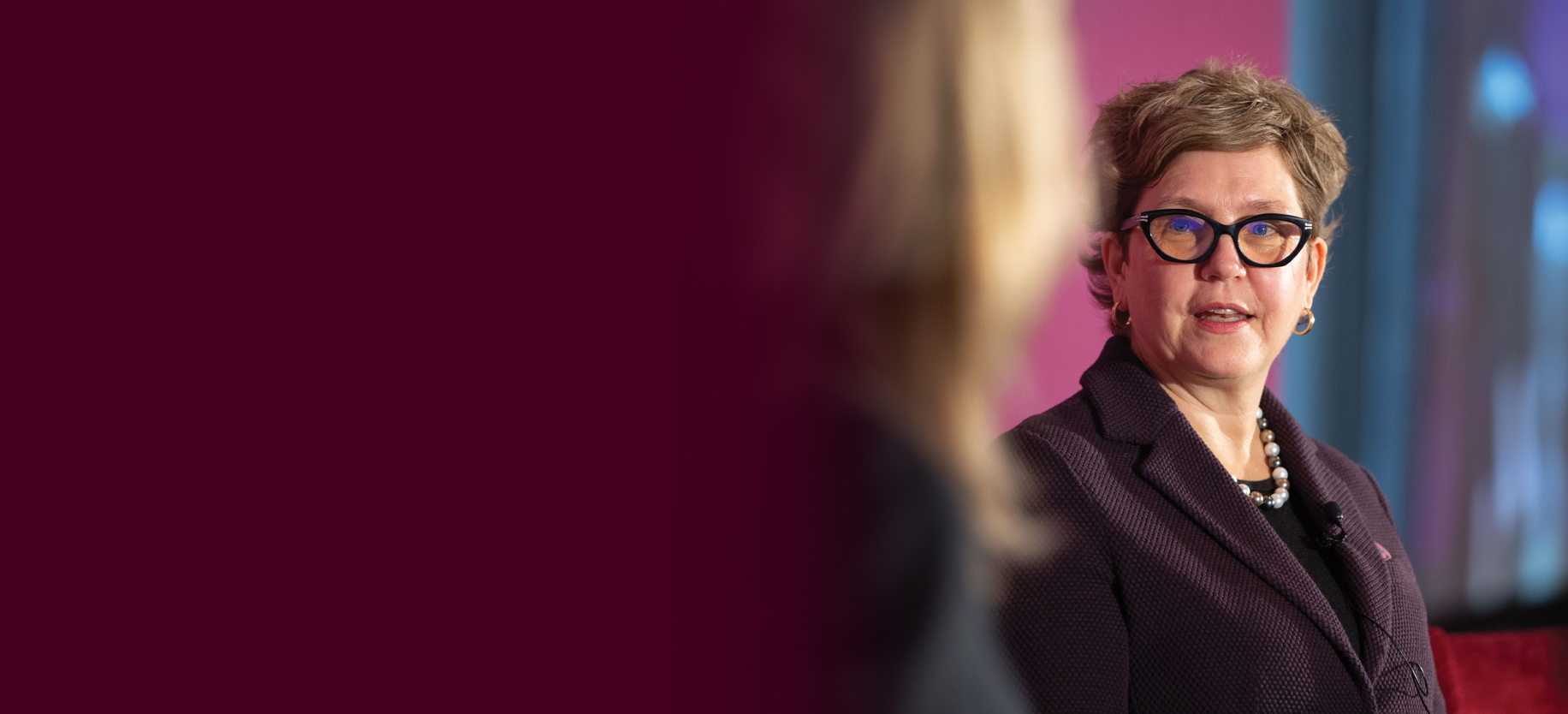
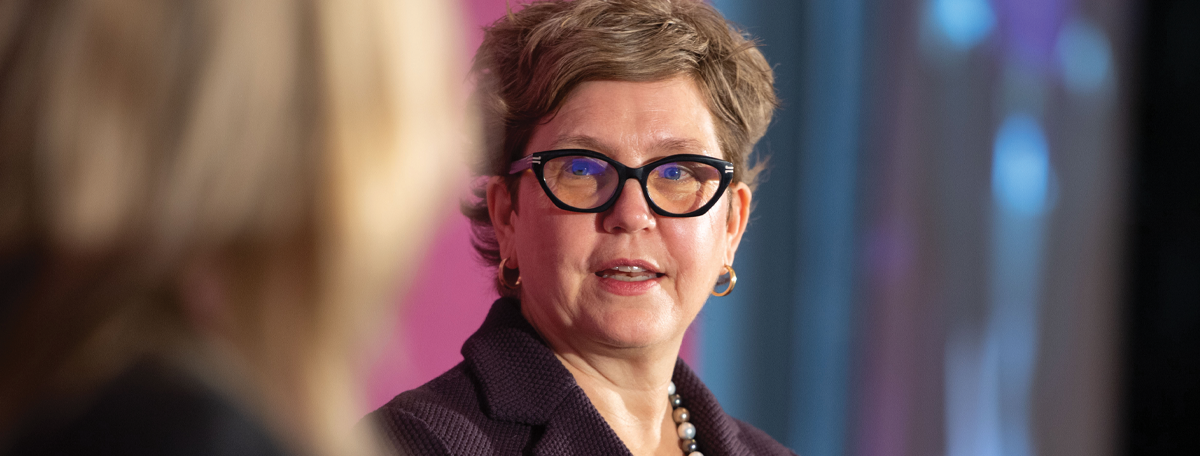
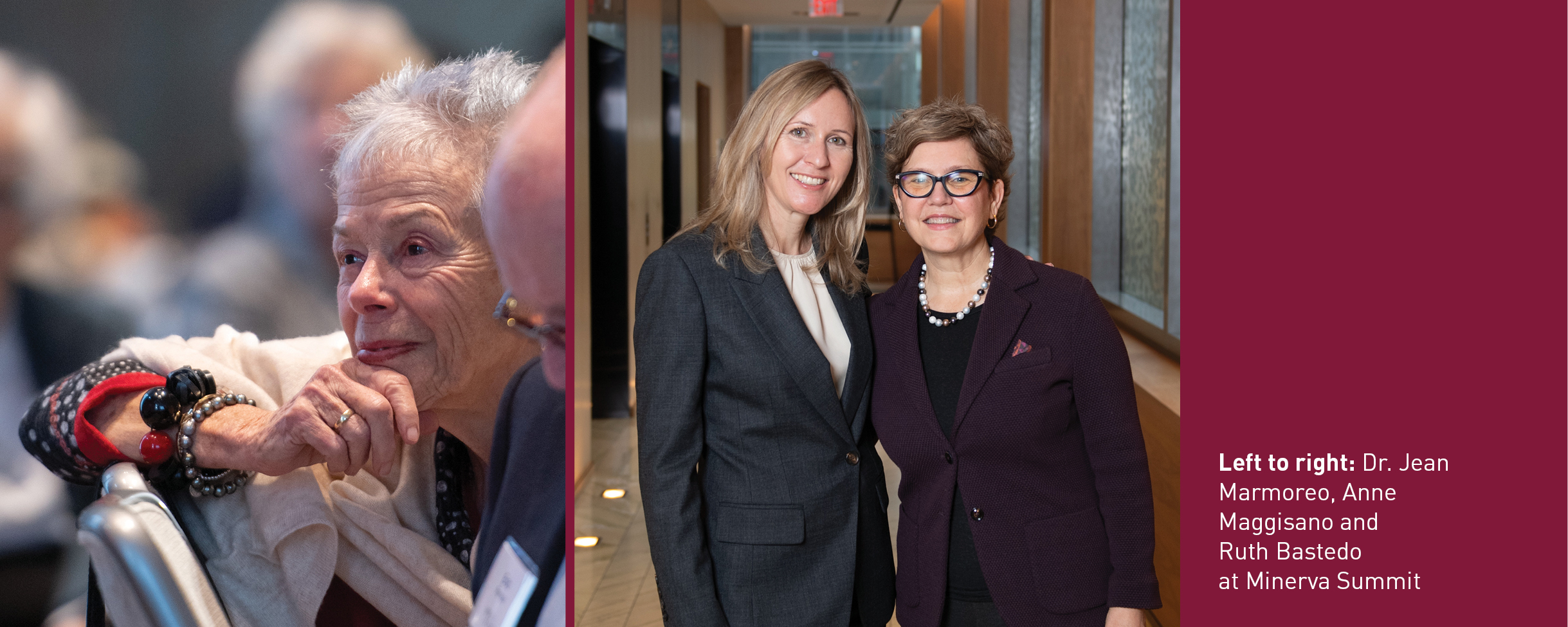
Ruth Bastedo is the Vice President, Senior Business Consultant at William Thomas Digital, an independent marketing agency purpose-built to deliver exceptional, tech-enabled customer experiences. A long-time volunteer on not-for-profit boards, Ruth is also the Chair of the Board of Hospice Toronto, an organization she became involved with after her father was diagnosed with a rare form of dementia. A self-described member of the sandwich generation, Bastedo intimately understands the vital and difficult work of acting as a caregiver for a loved one. At the Minerva Summit, she sat down with Burgundy Vice President Anne Maggisano to share her experience of caring for her father during his progressive illness, building support networks, managing the cost of care and how to support a loved one without losing yourself in the process.
Anne Maggisano: I’m going to start by asking you, Ruth, why did you say yes to speaking to our community today?
Ruth Bastedo: I’m a big fan of Women in Burgundy. I think what you are doing here and what you have accomplished over the last 10-plus years is important—it’s important that women have these conversations. My mother managed money professionally for 38 years. A lot of her clients were older women. So, I grew up seeing her help women navigate all these various phases of their lives from a wealth-management lens.
I had a grandmother who passed away at 102 and a great-aunt who passed away at 103. So, while my father was ill, my mother was still managing the care of her great-aunt. This is the sandwich-generation model—I represent the Gen X version, but with these long lifespans, we could be caring for elders going up into our 70s and 80s. This impacts your ability to manage your wealth and resources, but also your ability to manage your career, your kids, and the rest of it. That’s why I’m here. We’ve got to talk about this stuff.
AM: You come from a strong legacy of women, and you’re a champion for women yourself. How do you think about women in caregiving in the context of our increased longevity and the widening gap between our healthspan and our lifespan?
RB: Well, I think it’s still women who, whether we like it or not, are managing a large part of care. I’m not saying that care these days doesn’t include all different parts of the family. This is truly a multi-generational exercise when it works at its best, but it still has a very potent impact on women’s lives. When I became involved in Hospice Toronto, one of the things I became much more aware of is the impact of caregiving on women’s lives in all kinds of different contexts. It can impact your employment, it can impact your ability to look after your own kids, it can impact your relationships within your family.
AM: Let’s talk about where your conviction came from around women in caregiving—it really started with your experience with your dad’s illness. Can you paint a picture of what happened?
RB: My father was diagnosed with Primary Progressive Aphasia—[the type of dementia that] Bruce Willis has. The diagnosis came just before COVID-19, giving us a bit of time to get a handle on what we faced. We were fortunate to get a geriatrician and build some support around the medical aspects of his illness. We were made to understand early on that it was a progressive illness—these illnesses only go one way. As a family, we had to prepare. You get the information as you need it. There were four years where we were all very actively involved in his illness. He passed away in February of 2023.
“One of the things I became much more aware of is the impact of caregiving on women’s lives.”
AM: And what would you say united your family during this time?
RB: My father was a lawyer, so we were fortunate that he had documented his wishes from a very early phase. I found André Picard’s fabulous book, Neglected No More, at our cottage recently. My father had gone through and annotated it. He was educating himself as we were all learning what his diagnosis would mean for our family.
We focused on aligning what he wanted and needed, with what we could realistically do—sometimes those are two different things. We kept figuring out that balance. My mother is an extremely competent and capable woman, but it was her partner, so she needed help and support. We really rallied the troops across the family and got engaged in community organizations. The Aphasia Institute was important. The Alzheimer’s Society and Hospice Toronto proved amazing for me—both helped us with learning about our options for caregiver supports and how to support someone to have a good life, even with this awful diagnosis.
My father loved life—he loved to travel; he loved to read. As a family, we tried to maintain the spirit of those things he enjoyed. We took a road trip to Northern Ontario—my mother, my aunt, and myself. We figured a three-to-one ratio was probably about right. When something like this happens, it forces everyone to slow down and prioritize human connection. I’m proud of our family and how we came together.
AM: As you think back on that period, there must have been some areas that were unexpected.
RB: André Picard said, “If there is no strong-willed dedicated family member to navigate the complicated bureaucracy, elders often end up in institutional care by default, and that is especially true of those who live alone.” What struck me about that statement, which was part of my experience, is the amount of effort it takes. The project-management aspect, being assertive, being on top of where you get your resources, and how you are going to implement private care to supplement public care. My mother stick-handled a lot of it, but I think we were all a pretty good team.
You may have [developed a system] that’s working well, but then the disease or illness goes into a different phase and you have to do something totally different. Being able to evolve and have conversations with your family takes a big piece out of your life.
That’s what was most surprising. By the end, we were all a little burnt out. Other things took a hit, whether it was work, careers, kids, or other priorities. This is a bit of a surprise for people who are used to working and living in a high-performance situation; having a loved one with dementia in your life is a totally different experience than the business world. You must shift, and that took a while to get used to.
AM: How would you suggest a family start planning for these kinds of conversations?
RB: First, at least in our situation, was getting a level set on the situation: What is the illness? What is the true situation you’re dealing with? Whether you’re an older person or an adult child, somebody has to start this difficult, uncomfortable conversation about what is really going on. It could be anything from, “Oh, mom seems a little forgetful lately,” to some big inciting incident like a fall. You can then activate the medical component.
Next is getting a handle as early as possible on what your loved one wants. How do they want to live out this phase of their life? Do they want to stay in their home? Are they open to some kind of hybrid situation? What are their end-of-life wishes? My father documented this in a living will, and that document was honestly invaluable. It outlined different things that provided guidance on that last part of his life. My mother has one now too. We are working on similar documents in my family.
Then you need a plan, and a community and resources to support that plan. I was part of the Women in Philanthropy for Providence for 10 years before caring for my father. I learn by getting engaged in things, which is why I got involved with Hospice Toronto. There are lots of different resources and options out there. Educating yourself before there is a crisis is key. You do not want to have a crisis and be doing that groundwork while you are making big serious decisions.
AM: You’re talking about having the tough conversations, and one topic that must come up has to do with money.
RB: Money, yes. Getting old and being ill is expensive, particularly with illnesses like dementia, where you need a lot of care. We knew my father wanted to stay home as long as possible. He did until we just couldn’t continue because there were medical issues we couldn’t manage. What we ended up doing was going into a home-like retirement home. Temmy Latner, who does in-home hospice care, came in to support us for those last few weeks. It was a very peaceful experience, and we had our own private nursing and PSW support.
But putting all of that together and doing it over a long period of time is jaw droppingly expensive. It could easily be tens of thousands of dollars a month, particularly when you’re in some of the private retirement homes in midtown Toronto. There are wonderful private resources in Toronto. We had excellent care. But you still have to manage it—it doesn’t manage itself.
AM: So, Ruth, what do you think gets in the way of planning?
RB: These are not topics we like to talk about. Every family has their issues and blockages—whatever family dynamics you have in your family will be the same family dynamics you have during this crisis. That’s just how it is, right? The best you can do as a family is decide, “Okay, we’re going to pretend to be functional, and we’re going to put a stake in the ground. What would we do if we were a functional family to handle this crisis?” That is your guiding light.
We pulled it off, with my aunts and friends. I would be setting up Zoom calls with my dad’s old friends from university. My brother, who’s an artist, did beautiful paintings and photography sessions with him. He did the 24-hour acute care sessions. My other brother hung out with him. Everybody did their part. My husband and kids were great. But the lion’s share of it, of course, fell to my mother.
AM: In the desire to control and take care of everything, how can we keep in mind what matters most?
RB: It’s looking after yourself in all of this. If you burn out, are not able to function, and you’re the one providing the support, then the whole thing falls apart. That one thing is, in many ways, one of the hardest things to do. Know when you need to take a time out; know when you need a break.
One of the things our geriatrician told me when my father was near the end was: “Watch out for your mom.” What often happens is the spouse, in particular—but it could be another person—is so burnt out that they get sick afterwards. It is about finding that balance of having the right supports in place and taking care of your own mental health—and the mental health of those around you. Ask, “Do you need a break?” or “Is this good for you?” and being very conscientious about it.
A person who is gravely ill is a vortex. Everything is around that person, and it could go on for years. The needs of other people and yourself can get deprioritized. I’m just now starting to feel like my old self—a different version of my old self, but it has been a five-year chunk of time. It takes a while to come out of these experiences. But I feel we put everything out on the table for my dad, and I am very much at peace.
This post is presented for illustrative and discussion purposes only. It is not intended to provide investment advice and does not consider unique objectives, constraints or financial needs. Under no circumstances does this post suggest that you should time the market in any way or make investment decisions based on the content. Select securities may be used as examples to illustrate Burgundy’s investment philosophy. Burgundy funds or portfolios may or may not hold such securities for the whole demonstrated period. Investors are advised that their investments are not guaranteed, their values change frequently and past performance may not be repeated. This post is not intended as an offer to invest in any investment strategy presented by Burgundy. The information contained in this post is the opinion of Burgundy Asset Management and/or its employees as of the date of the post and is subject to change without notice. Please refer to the Legal section of this website for additional information.
